Fractional CCO for MedTech: Scaling Commercialization 2026
The eighteen months after regulatory approval are the most dangerous stretch in a MedTech company's life. A fractional CCO installs the commercial architecture that turns clinical evidence into predictable revenue — without the overhead of a permanent executive hire.

The most dangerous period for a MedTech startup isn’t the clinical trial phase; it’s the eighteen months following regulatory approval when a lack of commercial architecture turns innovation into a liability. You’ve spent years perfecting the technology, yet you likely find your bandwidth consumed by sales messaging and GTM logistics instead of high-level fundraising. It’s a common trap where clinical data fails to translate into market share, leaving leadership exhausted and investors restless. This is why forward-thinking organizations are now deploying a fractional chief commercial officer medtech specialist to install the necessary systems without the heavy overhead of a permanent executive hire.
You understand that a product launch is a systemic architecture, not just a sales activity. This article details how an elite fractional leader bridges the gap between medical device innovation and sustainable market dominance. You’ll learn to navigate the 2026 landscape, from FDA QMSR compliance to the EU AI Act, while accelerating your market entry. We’ll preview the strategic alignment required to turn clinical evidence into predictable revenue growth and reclaim your bandwidth for the boardroom.
Key Takeaways
- Identify why clinical excellence often fails to scale and how to move beyond the founder-led sales plateau that limits institutional growth.
- Learn how a fractional chief commercial officer medtech acts as a strategic architect to align clinical data, marketing, and sales for sustainable market dominance.
- Analyze the financial impact of the fractional model on organizational valuation and investor readiness compared to the overhead of a full-time executive hire.
- Explore the 90-day playbook for operationalizing growth, including the critical commercial audit and the implementation of The Bridge Strategy™.
- Discover how “uncommon market entry” strategies can bypass traditional sales bottlenecks and accelerate your medical device’s path to revenue.
The MedTech Commercialization Gap: Why Innovation Often Fails to Scale
Innovation is not a strategy. For many MedTech organizations, the transition from a breakthrough clinical trial to a sustainable revenue stream is where the vision fractures. This is the commercialization gap: the precise point where clinical excellence fails to translate into market share. While your engineering team has solved the technical hurdles, the commercial infrastructure often remains an afterthought. Without a Chief Commercial Officer (CCO) to architect the go-to-market engine, even the most disruptive devices often wither on the vine.
Many firms hit a “founder-led sales” plateau. The CEO, driven by passion and deep technical knowledge, secures the initial pilot sites. However, this model is inherently unscalable. Founders eventually run out of bandwidth, leaving them unable to manage complex GPO (Group Purchasing Organization) contracts or navigate the intricate bureaucracy of IDNs (Integrated Delivery Networks). Scaling requires a shift from individual effort to institutional systems. An experienced fractional chief commercial officer medtech professional intervenes here, installing the repeatable processes needed to move beyond the founder’s personal network.
The Valley of Death in Medical Device Launches
The distance between a successful R&D milestone and commercial readiness is often underestimated. Companies frequently focus on regulatory clearance as the finish line, yet that is merely the starting block. Inadequate market access strategies lead to a “valley of death” where burn rates soar while adoption lags. Hiring a full-time executive at this stage is a high-risk gamble that often leads to “learning on the fly” at the company’s expense. A fractional leader provides the strategic roadmap to avoid these costly detours.
Systemic Alignment: Clinical, Marketing, and Sales
Commercial friction is usually the result of siloed departments. When clinical data isn’t translated into marketing collateral that resonates with economic buyers, or when sales teams don’t understand the nuances of the clinical evidence, the narrative breaks. A fractional chief commercial officer medtech ensures that every department speaks the same language. Commercialization Effectiveness is the precise alignment of clinical value with the specific needs of economic buyers and healthcare stakeholders.
What is a Fractional Chief Commercial Officer (CCO) in MedTech?
A fractional chief commercial officer medtech is a strategic architect embedded directly within your leadership team. Unlike a generalist consultant who delivers a static report and departs, this executive owns the commercial roadmap. They operate as a high-level partner, managing the entire commercial lifecycle from clinical evidence translation to final market adoption. This role is distinct from a Chief Revenue Officer (CRO), who typically focuses on the mechanics of sales execution and pipeline velocity. While the CRO builds the engine, the CCO designs the entire vehicle, ensuring it’s fueled by the right clinical data and steered toward the correct payers.
The CCO’s mandate covers the complex financial, regulatory, and implementation challenges that define the modern medical device sector. They synthesize market access, reimbursement strategy, and revenue operations into a single, cohesive movement. This is not a role for a generalist; it requires a deep understanding of how Class II and III devices navigate the hospital value analysis committee (VAC) and the broader healthcare ecosystem. They bring the pattern recognition necessary to spot commercial landmines before they detonate.
Strategic Ownership vs. Tactical Execution
An elite fractional chief commercial officer medtech manages your existing teams and agencies. They don’t just provide advice; they own the commercial P&L and the growth roadmap. This level of seniority is critical when negotiating with IDNs or refining GTM strategies for high-stakes surgical platforms. Advice is cheap, but operator experience is rare. These leaders have sat in the boardroom through failed launches and successful exits. They know exactly where the structural weaknesses lie in a commercial plan. If you find your current commercial efforts stalling, a specialized Fractional CCO service can provide the necessary course correction.
The Fractional Model: Seniority Without the Overhead
Startups often lack the capital for a massive annual executive salary, but they cannot afford the cost of a failed launch. The fractional model solves this by providing 1 to 3 days per week of veteran leadership. You aren’t buying a block of hours; you’re buying decades of pattern recognition. This cadence provides maximum leverage, allowing the organization to benefit from an external perspective forged across multiple commercializations. It’s a strategic intervention that brings boardroom-level expertise to a growing team without the permanent drag on your balance sheet. You get the architect you need at the price of a builder.
Evaluating the Fractional Model: Strategic Impact and ROI
The decision to hire a full-time executive is often treated as a milestone of success, yet for many MedTech firms, it’s a premature drain on vital capital. A traditional C-suite search in this sector typically lasts six to nine months, followed by another six months of executive ramp-up. By the time a full-time hire is fully operational, the market window may have narrowed or closed entirely. In contrast, a fractional chief commercial officer medtech specialist provides an immediate strategic intervention, bypassing the recruitment lag and the significant equity dilution associated with permanent hires.
Skeptics often ask if a part-time leader can truly master complex medical technology. This question misidentifies the core value of an executive. You don’t hire a CCO to perform the engineering; you hire them to architect the commercial machine. Elite fractional leaders possess the pattern recognition to understand your clinical value proposition within days because they’ve successfully navigated similar regulatory and reimbursement landscapes multiple times. They bring a level of objectivity that full-time employees, often insulated by company culture, cannot provide.
Full-Time vs. Fractional CCO: A Strategic Comparison
The total cost of ownership for a full-time CCO includes not just a high base salary and benefits, but also significant signing bonuses and long-term equity commitments. The risk of a “bad hire” at this level is catastrophic, often costing a company two to three times the executive’s annual salary in lost time and momentum. A fractional chief commercial officer medtech offers a flexible alternative, allowing the organization to scale leadership intensity based on the current phase of the clinical-to-commercial transition. You gain the impact of a veteran operator without the rigid, long-term financial burden.
- Immediate Impact: Fractional leaders start delivering strategy in weeks, not months.
- Reduced Equity Dilution: Preserve cap table health for future funding rounds.
- Operational Flexibility: Adjust the engagement level as you move from pilot sites to national rollout.
Driving Enterprise Value for MedTech Startups
Professionalizing your commercial engine is a prerequisite for successful Series B or C funding. Investors don’t just buy products; they buy predictable revenue architectures. A fractional CCO installs the systems and reporting structures that demonstrate market traction to institutional VCs. By establishing a robust commercial roadmap, you effectively reduce the “risk discount” applied by investors who fear the volatility of founder-led sales models. This strategic preparation is equally vital for companies eyeing an acquisition or IPO, as it proves the technology has a viable, scalable path to market dominance.
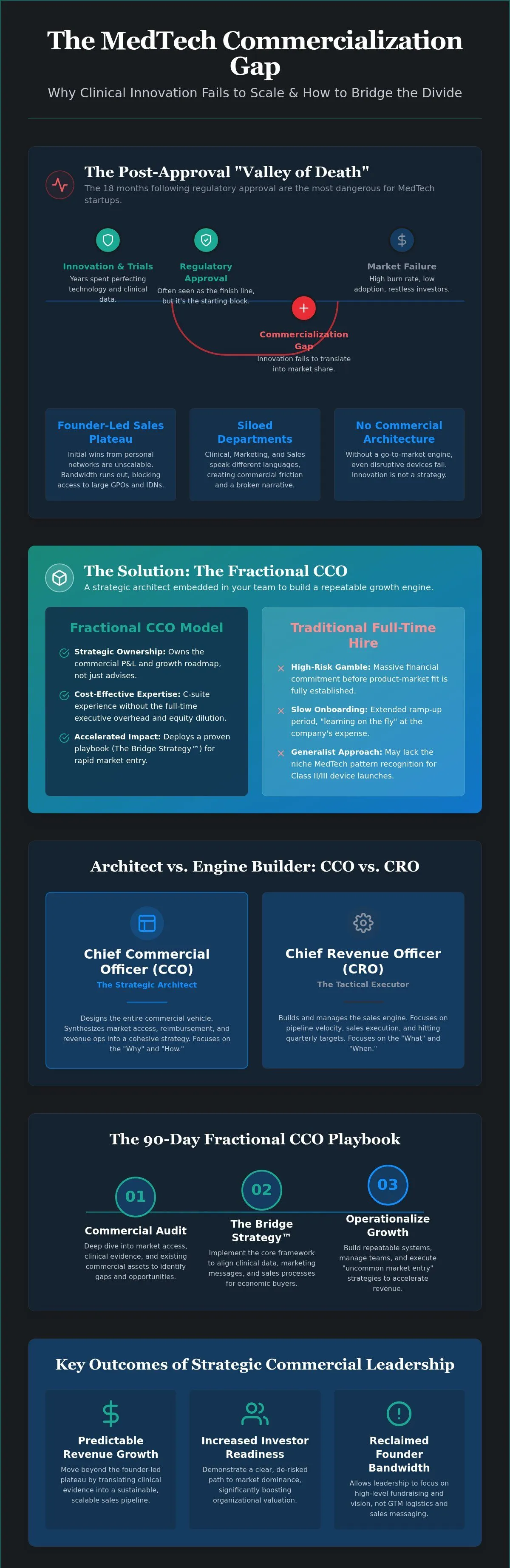
The 90-Day Fractional CCO Playbook: Operationalizing Growth
A fractional chief commercial officer medtech specialist doesn’t have the luxury of a 100-day “listening tour.” Time is the most expensive resource in a venture-backed startup. The first 90 days must be a tactical sprint to identify systemic friction and replace it with a professionalized commercial architecture. This playbook moves beyond generic marketing advice to address the specific regulatory, clinical, and economic hurdles that define the medical device industry. Every action is designed to turn clinical evidence into a scalable revenue engine.
The Audit Phase: Identifying Commercial Friction
Days 1 through 30 are dedicated to a high-stakes commercial audit. This isn’t a surface-level review of marketing slides. It’s a deep dive into the reality of your GTM effectiveness. We interrogate the sales pipeline to distinguish between “hopeful leads” and actual clinical adoption. We audit distributor networks to see if they’re actually representing your technology or simply collecting a margin. Most importantly, we identify the messaging gap where clinical data fails to resonate with the economic buyers at the hospital level. If your sales team is talking to surgeons while the hospital’s CFO is the one blocking the purchase, that’s a systemic failure we correct immediately.
During the second month, we transition to strategy refinement. This is the stage where we deploy The Bridge Strategy™ to move from founder-led sales to a scalable commercial engine. We refine the Ideal Customer Profile (ICP) to ensure your team isn’t wasting time on clinical champions who lack the political capital to clear a Value Analysis Committee (VAC). We build the bridge between what the clinical evidence proves and what the Integrated Delivery Network (IDN) needs to see to grant market access.
Execution: Launching High-Impact Initiatives
The final phase, spanning days 61 to 90, focuses on operational execution. We install a predictable Revenue Operations (RevOps) framework that tracks more than just top-line sales. We measure pipeline velocity and market access milestones, such as successful GPO contract inclusions or formulary wins. We provide sales enablement tools that empower the field to handle the specific objections of value-based healthcare. This ensures that every member of the commercial team is executing a unified strategy with clear accountability.
By the end of this 90-day cycle, the organization possesses a 12-month commercial roadmap. You aren’t just looking for “more sales”; you’re building a system that makes revenue growth a predictable outcome of clinical value. If your current launch is stalling or your commercial team lacks a clear direction, it’s time for an elite intervention. You can book a Fractional CCO consultation to begin your 90-day turnaround and reclaim your commercial momentum.
Implementing The Bridge Strategy™: Elite Leadership for MedTech
The Bridge Strategy™ is the definitive proprietary framework for organizations that refuse to settle for mediocre market penetration. While many firms rely on generic marketing templates, this architecture is built specifically for the high-stakes environment of medical device commercialization. It addresses the systemic gaps between clinical proof and economic purchase, ensuring that innovation translates into institutional adoption. By utilizing a fractional chief commercial officer medtech expert, your organization gains access to this elite methodology, ensuring your technology doesn’t just enter the market but establishes sustainable dominance.
Uncommon Market Entry for Medical Devices
Most failing launches follow the same tired script: hire more sales representatives and hope for the best. In the modern US healthcare landscape, increasing headcount without institutional alignment is a recipe for accelerated burn. The Bridge Strategy™ prioritizes “uncommon market entry” by identifying the specific institutional bottlenecks within GPOs and IDNs. We focus on strategic partnerships and institutional alignment rather than sheer volume. This approach bypasses traditional sales bottlenecks by speaking the language of the hospital boardroom, ensuring your technology is seen as a strategic solution to their operational challenges rather than just another line item expense.
Navigating the complexities of the US healthcare system requires more than a tactical sales plan; it requires a deep understanding of value-based care and reimbursement pathways. An elite fractional chief commercial officer medtech professional understands that the surgeon is no longer the only customer. The true decision-makers are often found in the Value Analysis Committee (VAC), where economic evidence is scrutinized as heavily as clinical data. Our framework ensures your commercial engine is optimized to win these high-stakes evaluations.
Coaching the Next Generation of MedTech Leaders
A commercial strategy is only as effective as the leaders executing it on the ground. This is why specialized coaching for executive and mid-level leaders is a core component of our intervention. A fractional leader doesn’t just hand over a roadmap; they build the leadership capacity to sustain it. We ensure that your commercial narrative is executed with clinical precision at every level of the organization, from the boardroom to the field. This creates a culture of high-level effectiveness that remains long after the initial scaling phase is complete.
Int’l Commercialization Growth Partners positions firms for high-level product launch effectiveness by installing the systems that investors and acquirers demand. You have the innovation. Now you need the architecture to scale it. Optimize your commercial strategy with our team to ensure your product launch achieves the market dominance it deserves.
Securing Market Dominance Through Strategic Commercial Architecture
Innovation alone is no longer a guarantee of market success. The 2026 landscape demands a sophisticated commercial architecture that aligns clinical data with economic value at every level. We’ve analyzed how the fractional model offers a high-leverage solution for scaling organizations, providing the senior leadership required to navigate GPO complexities and IDN hurdles without permanent fiscal drag. By deploying a fractional chief commercial officer medtech specialist, you transform your commercial operations from a series of disconnected tactical activities into a predictable growth engine. This is the elite intervention required to bridge the gap between clinical excellence and sustainable revenue.
Int’l Commercialization Growth Partners provides the specialized MedTech executive leadership and national expertise necessary for high-level product launch effectiveness. Through The Bridge Strategy™ for uncommon market entry, we help you bypass traditional sales bottlenecks and reclaim your executive bandwidth. It’s time to professionalize your commercial roadmap and secure the valuation your technology deserves. Schedule a Strategic Commercialization Audit to begin your transformation. Your path to market dominance starts with the right architecture.
Frequently Asked Questions
What is the difference between a Fractional CCO and a MedTech consultant?
A Fractional CCO is an integrated executive leader, whereas a consultant typically provides external advice without operational accountability. While a consultant delivers a report, an elite fractional chief commercial officer medtech specialist owns the commercial roadmap and manages internal teams. They function as a high-stakes partner who shares the burden of performance, ensuring that strategy isn’t just documented but executed with precision.
When is the right time for a medical device startup to hire a Fractional CCO?
The ideal time is during the transition from clinical validation to market entry, specifically when founder-led sales hit a growth plateau. This usually occurs 6 to 12 months before or immediately following regulatory approval. Hiring at this stage prevents the “valley of death” where burn rates outpace adoption due to a lack of commercial architecture and institutional systems.
Can a Fractional CCO help with FDA market access and GPO contracting?
Yes, they are essential for translating clinical evidence into the economic language required by Group Purchasing Organizations (GPOs). A CCO doesn’t just navigate regulatory hurdles; they architect the market access strategy that secures formulary wins and contract inclusions. They ensure your technology meets the specific value-based requirements of modern hospital committees and Integrated Delivery Networks (IDNs).
How many days per week does a Fractional CCO typically work?
Most engagements follow a cadence of 1 to 3 days per week based on the organization’s current scale and goals. This structure provides the strategic seniority of a veteran operator without the drag of a permanent executive salary. It allows for high-efficiency briefing and rapid decision-making while maintaining the flexibility to scale involvement as the commercial engine matures.
What does a Fractional CCO cost compared to a full-time executive?
A fractional leader provides a significant reduction in the total cost of ownership compared to a permanent hire. You avoid the heavy expenses of executive recruitment fees, signing bonuses, and extensive benefit packages. Perhaps most importantly, it limits cap table dilution, preserving equity for future funding rounds while providing immediate boardroom-level expertise and pattern recognition.
How does a Fractional CCO integrate with our existing VP of Sales?
The CCO operates as the strategic architect while the VP of Sales focuses on tactical execution and pipeline management. This relationship removes the strategic burden from the VP, allowing them to lead the field team with a clear, unified narrative. The CCO ensures that sales efforts are aligned with marketing, clinical data, and long-term enterprise value goals.
What is The Bridge Strategy™ and how does it apply to MedTech?
The Bridge Strategy™ is a proprietary framework designed to bypass traditional sales bottlenecks through uncommon market entry. It focuses on institutional alignment and strategic partnerships rather than simply increasing sales headcount. This methodology ensures that every commercial activity is optimized for high-level effectiveness within the complex and bureaucratic US healthcare landscape.
Can a Fractional CCO help prepare my MedTech company for an exit?
They are critical for maximizing valuation by building a predictable, scalable revenue architecture. Investors and acquirers apply a risk discount to companies with erratic sales or founder-dependent growth. An experienced fractional chief commercial officer medtech professional professionalizes the organization’s commercial engine, making it a highly attractive asset for potential acquisition or IPO.
Written by Craig T. Ingram, Co-founder · Chief Commercialization & Strategy Advisor.